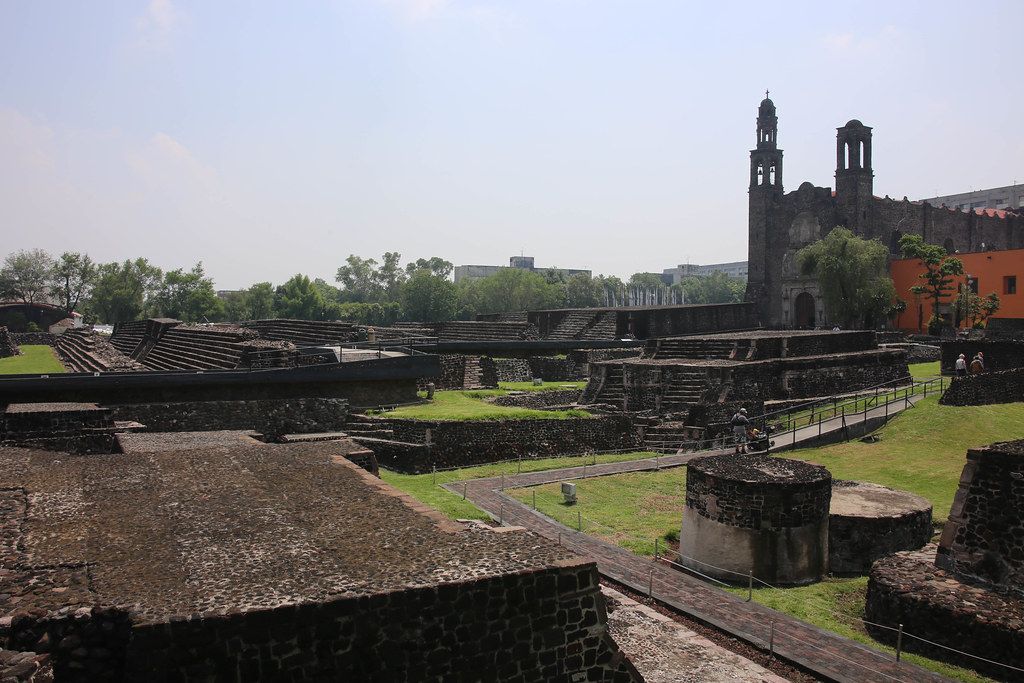
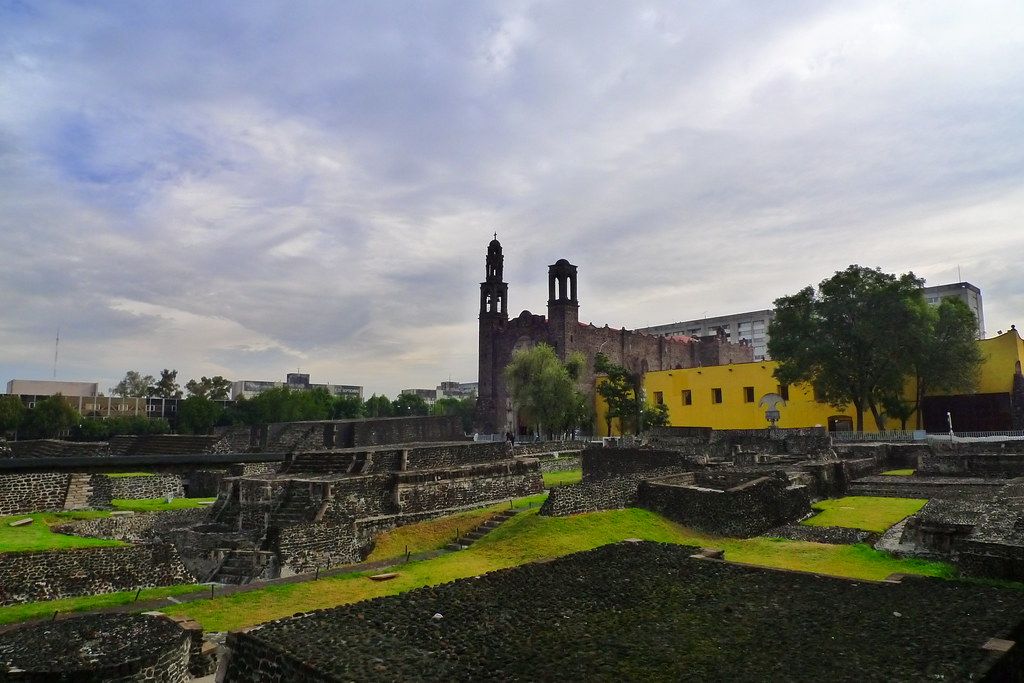
The Plaza de las Tres Culturas, in Tlatelolco just north of the Centro, gets its name from the three layers of history that stand side by side: Mexica ruins, a Spanish colonial church and a twentieth-century housing estate. Few places in the city show its past so plainly in one view. It is also a site of mourning, because of what happened here on 2 October 1968 and again in the 1985 earthquake.
The Mexica city of Tlatelolco
Before the Spanish arrived, Tlatelolco was a separate city on the same island as Tenochtitlan, founded by a group of Mexica who split off from their neighbours. It was absorbed by Tenochtitlan in the fifteenth century but remained famous for its huge market, where traders brought goods from across Mesoamerica. Spanish soldiers who saw it wrote about the size and order of the market with astonishment.
The archaeological zone in the plaza shows the bases of temples and platforms, including the layered stones of the main pyramid, rebuilt several times like the Templo Mayor in the Centro.
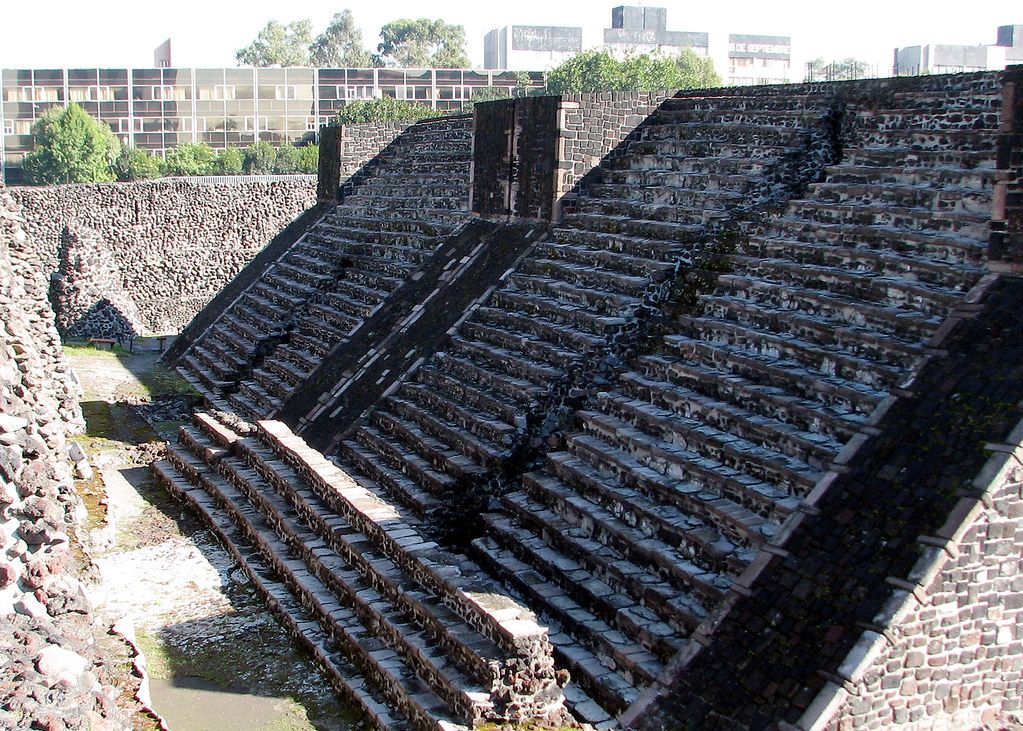
Walkways run around and through the ruins. Burials and offerings found here are displayed nearby. It was at Tlatelolco that the last Mexica resistance ended in August 1521, when Cuauhtémoc was captured. A stone tablet in the plaza describes that day as neither a triumph nor a defeat, but the painful birth of the mestizo nation.
The church of Santiago
On the east side of the ruins stands the church of Santiago Tlatelolco, a heavy stone building finished in the early seventeenth century, partly built with stones taken from the temples beside it. Next to it are the remains of the Franciscan college of Santa Cruz de Tlatelolco, founded in the 1530s to educate sons of the indigenous nobility. Friars and native scholars there produced some of the most important records of Mexica language and life. The church is usually open; it is a working parish, so dress modestly and be quiet inside.
The housing estate
All around the plaza rise the long concrete slabs and towers of the Nonoalco-Tlatelolco housing estate, designed by the architect Mario Pani and completed in the 1960s. It was one of the largest housing projects in Latin America, a city within the city with its own schools, shops and gardens, built to show off a modern, confident Mexico. For many families it is still home.  Transfer to station 1·01The Centro Histórico, from the Zócalo out Walk through with the respect you would show any residential area.
The tall tower on the south side of the plaza was built as the Foreign Ministry and now houses the Centro Cultural Universitario Tlatelolco, part of the national university. It has exhibitions and a permanent memorial to the events of 1968.
2 October 1968
In the summer and autumn of 1968, students and their supporters across Mexico City held marches against government repression, demanding civil rights. The Olympic Games were due to open in the city on 12 October, and the government was determined to show a calm face to the world.
On the evening of 2 October, several thousand people gathered in the Plaza de las Tres Culturas for a rally. Army troops and plain-clothes forces surrounded the plaza and opened fire on the crowd. Many people were killed, wounded or arrested, and some disappeared. The government at the time gave a very low death toll and blamed the students; the true number has never been settled and is thought to have been far higher, possibly in the hundreds. Later investigations and the release of documents confirmed much of what survivors said about the state's role.
A stone stele in the plaza lists names of some of the dead. Every year on 2 October, marches cross the city in remembrance, and the date is still a raw and political one. If you are in the city then, expect crowds and closures in the Centro and here.
The 1985 earthquake
On the morning of 19 September 1985, a powerful earthquake struck Mexico City, and thousands of people died across the city. In Tlatelolco, part of the Nuevo León building, one of the estate's large apartment blocks, collapsed, killing many residents. Other blocks were badly damaged and later demolished, which is why some gaps remain in the estate today. The disaster, and the slow government response, led ordinary people to organise their own rescues, and is remembered as a moment when the city's civil society came of age. You can read more about how the city prepares today in the guide to altitude, air and earthquakes.
Visiting
Tlatelolco is quick to reach on Metro Line 3 to Tlatelolco station, a short walk from the plaza. An hour or two is enough to walk round the ruins, look into the church and see the memorial. Pair it with the Centro Histórico, about ten minutes away by taxi, or with the Basilica of Guadalupe, further north on the same side of the city.
The ruins are in the open sun, so bring a hat and water. The area is a normal working neighbourhood, busy and generally relaxed in the day. As anywhere, keep valuables close, and take a licensed taxi or ride-hailing car if you leave after dark. Take your time and read the plaques: few places explain Mexico City as well.