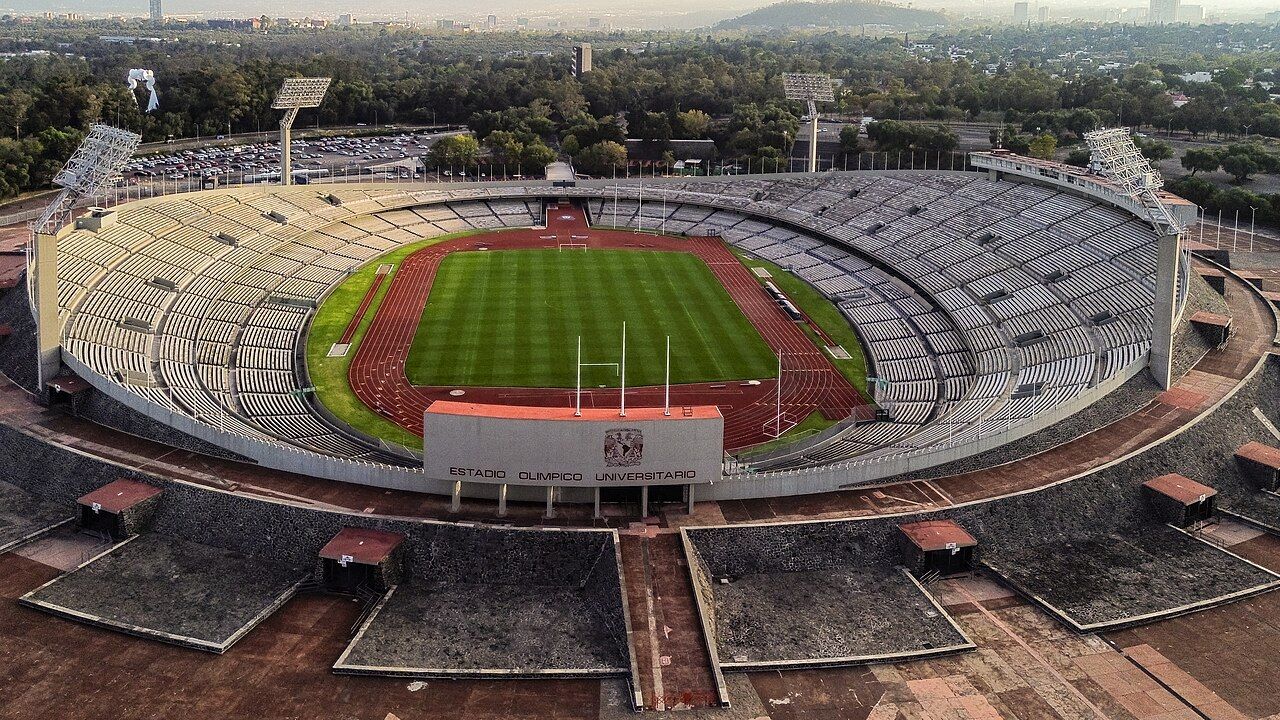
The Universidad Nacional Autónoma de México, known to everyone as UNAM, is the largest university in the country and one of the largest in the Americas. Its main campus, the Ciudad Universitaria or CU, was built in the early 1950s on a field of old lava in the south of the city. Dozens of architects and artists worked on it together, and the result is so complete an example of its age that UNESCO listed the central campus as a World Heritage Site in 2007.
A campus built on lava
Some seventeen centuries ago, the small Xitle volcano erupted at the southern edge of the valley and sent lava over what is now the Pedregal district. The rock cooled into a rough black landscape of ridges and caves, hard to farm and long left wild. When the university needed space to grow, the planners chose this ground and made the stone part of the design.
You see it everywhere. Walls are built of the same volcanic rock, gardens keep outcrops in place, and in some corners of campus the original lava scrub survives as an ecological reserve, with native plants, lizards and birds. The main buildings sit around a long, wide lawn, the Islas, which acts as the campus's central park. On a weekday it is full of students reading, sleeping and arguing in the sun.
The Central Library and the rectory
The building most people come to see is the Biblioteca Central, a tall, almost windowless block covered on all four sides with a mosaic designed by Juan O'Gorman. It is made of small natural stones in many colours, gathered from around Mexico, and it tells the history of the country's culture: the pre-Hispanic world on one side, the colonial period on another, and the modern university and the wider world on the others. Stand back on the lawn to take in the whole thing, then walk round slowly; each side has its own story and its own symbols.
A short walk away is the Rectoría, the administration tower, with a relief mural by David Alfaro Siqueiros on its southern face. Siqueiros wanted painting that leapt off the wall, and here he built figures out of shaped concrete covered in coloured glass mosaic, so that they push out toward you. The best-known panel shows students offering their learning back to the people, an idea the university still holds up as its purpose.
The same generation of artists that painted the Centro's walls worked here, but their style had moved on. If you have seen the murals of the Centro, you will notice how the painted walls of the 1920s became stone and concrete on the outsides of buildings, made for a campus seen in the open air.
The Olympic stadium
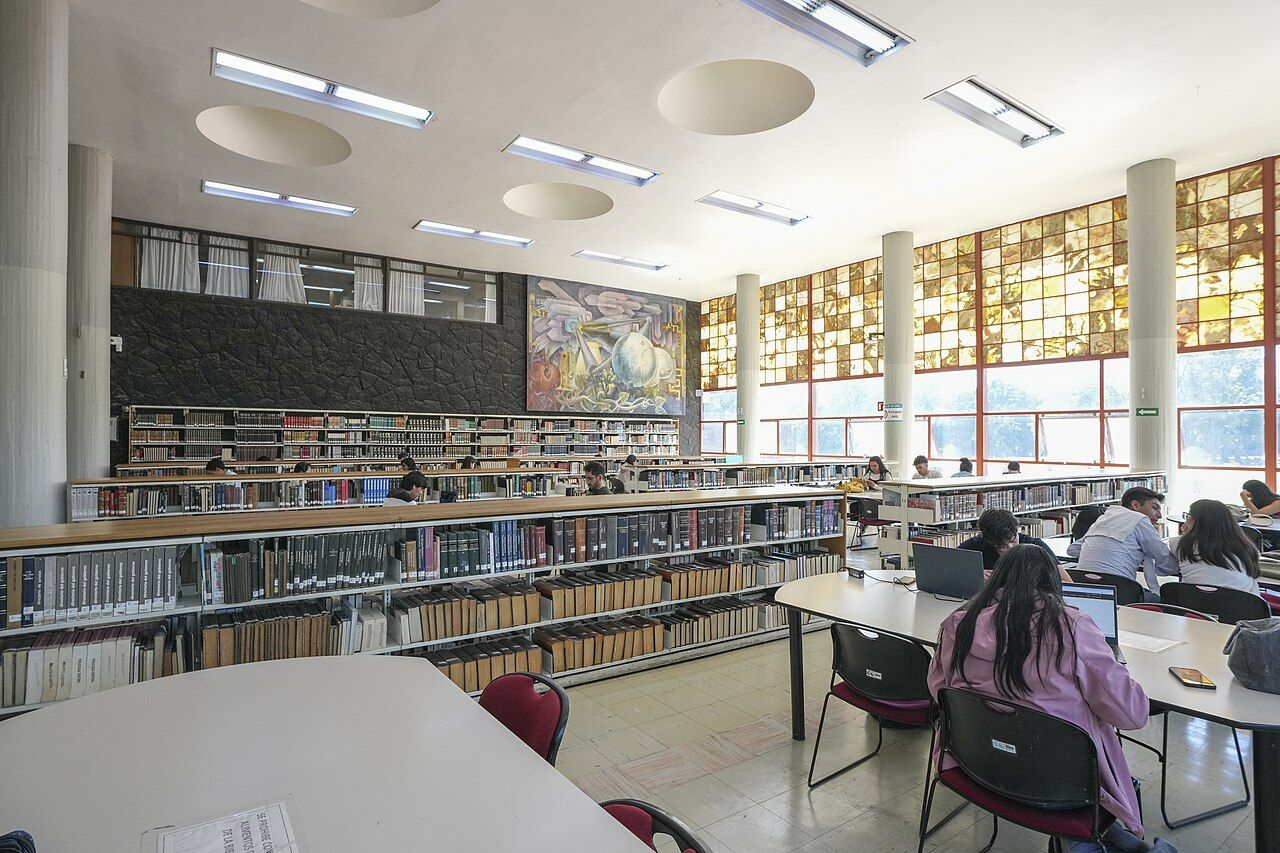
Across Avenida Insurgentes Sur stands the Estadio Olímpico Universitario, built in the same years as the campus and later the main stadium of the 1968 Olympic Games. Its low, sloping shape rises out of the lava like a crater, with the seating dug partly into the ground, so from outside it looks smaller than it is.
Over the main entrance is a relief by Diego Rivera, made of coloured stones and showing the university, sport and the family. Rivera planned to cover the whole outer wall but completed only this part.  Transfer to station 2·01The National Museum of Anthropology in one visit The stadium is the home ground of the university's football club, so on match days the area around it fills with fans, traffic and police.
The Espacio Escultórico
In the southern part of campus, among the cultural buildings, is one of the strangest and most peaceful places in the city. The Espacio Escultórico, made in 1979 by a group of artists, is a ring of sixty-four concrete blocks set around a raw circle of lava. There are no paths across the middle. You stand on the ring and look into a small, untouched patch of the old Pedregal, with its cracked rock, shrubs and small trees.
Nearby, smaller sculptures stand along a walking path through the reserve. The cultural zone also holds a university concert hall, theatres and the Museo Universitario Arte Contemporáneo, known as MUAC, a large, modern gallery with changing exhibitions. Like many museums in the city, it keeps its own opening days and charges an entry fee.
Getting around a very big campus
CU is far bigger than it looks on a map, and the sights cluster in two zones: the central campus around the library and rectory, and the cultural zone to the south with the Espacio Escultórico and MUAC. The stadium sits on the other side of the main road from the central campus. Walking between the zones takes a good while, much of it in full sun at an altitude of more than two thousand metres.
The university runs free internal buses on several routes for students and visitors, though the service is lighter at weekends and in holidays. Ask a student or look at the route maps at the stops. Metrobús Line 1 runs along Insurgentes to a stop at the edge of campus, and Metro Line 3 reaches Copilco and Universidad, both within walking distance of different parts. The guide to the Metro and Metrobús has more on the city lines.
When to go and how to behave
CU is a working university, so the best time is when classes are running and the campus is alive, or at weekends when it is quieter and families walk the lawns. During the long holidays some buildings and services close. Political meetings and student protests are a normal part of campus life; keep a respectful distance and do not photograph people without asking.
Bring a hat and water, since there is little shade on the Islas and the sun at this height is strong. Wear shoes that can handle rough rock if you want to walk the reserve paths. And give yourself time to sit on the lawn for a while in front of the library: it is the best way to see the place the way students do.