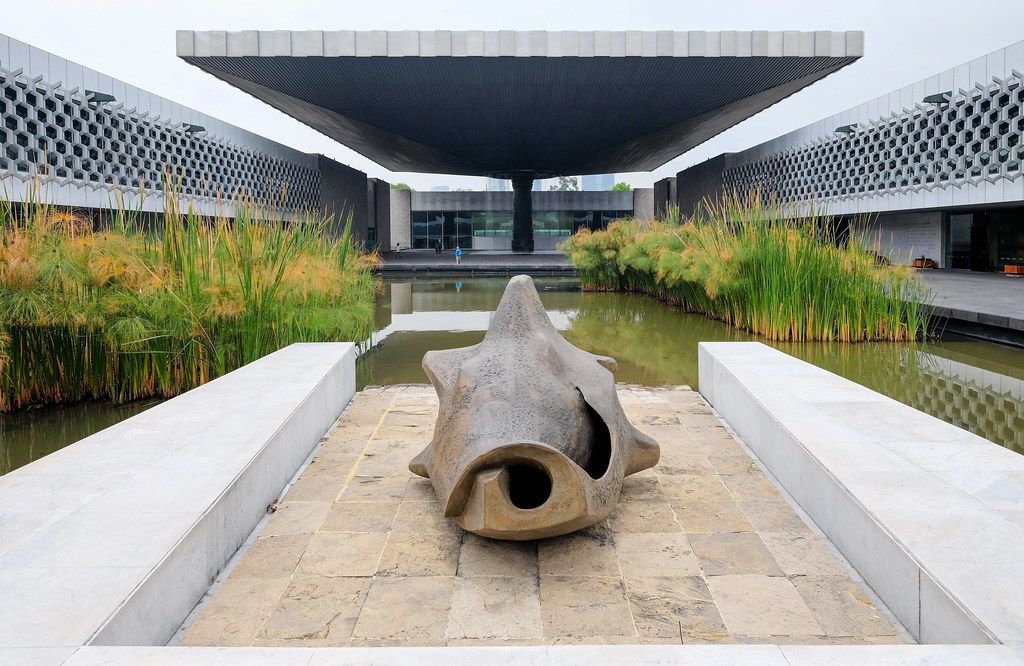
The Museo Nacional de Antropología sits on the north side of Chapultepec Park, a long, low building of stone and glass that holds the greatest collection of pre-Hispanic art in the world. Opened in 1964, it was designed by the architect Pedro Ramírez Vázquez and a team of others as a statement about Mexico's identity, and it still feels like one. You could spend days here. With a plan, you can see the heart of it in one visit.
Arriving and the umbrella courtyard
As you approach from Paseo de la Reforma, a colossal stone figure of the rain god Tláloc stands outside the entrance. It was moved here from a village east of the city in 1964, and the story goes that a heavy rainstorm broke as it arrived.
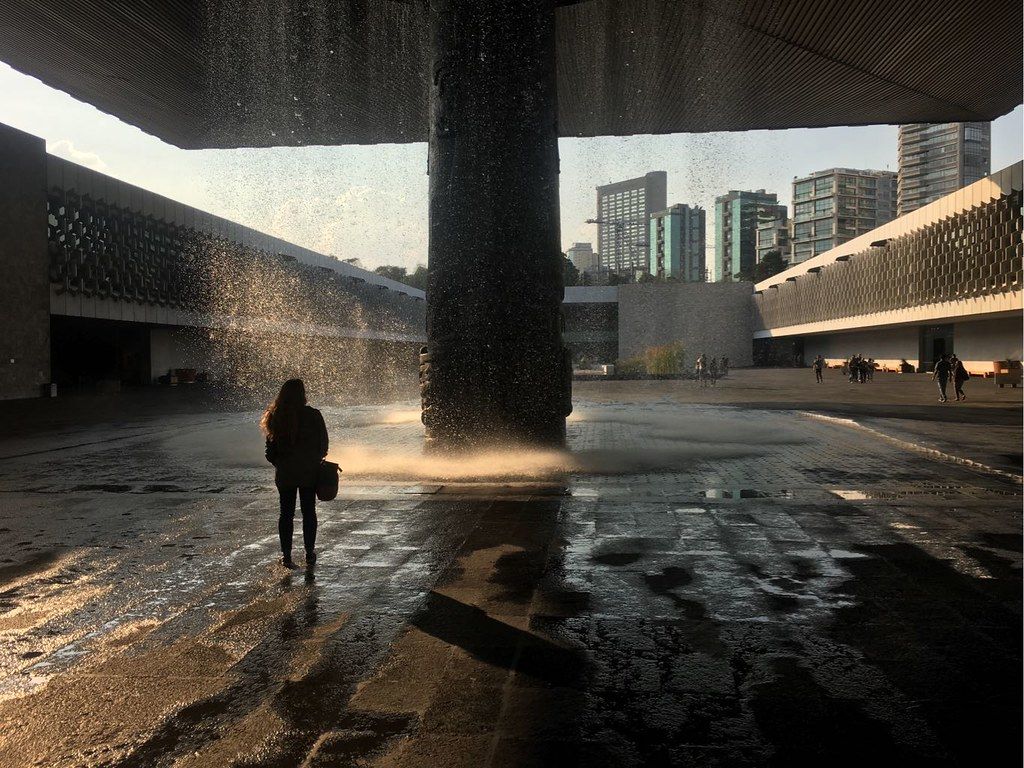
Inside, after the ticket desk and the bag check, you come out into a long central courtyard. Halfway along stands the museum's signature: a single huge bronze-clad column holding up a vast square roof, with a curtain of water falling from its edge into a pool. Everyone calls it the umbrella, el paraguas. The column is carved with reliefs about the history of Mexico, and on a sunny day the spray catches the light.
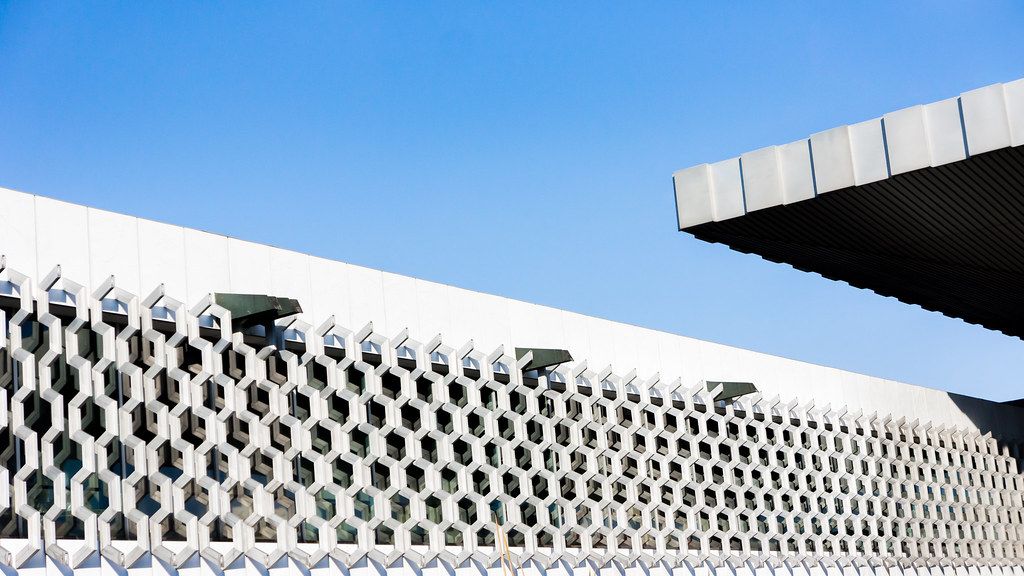
The layout is simple once you see it. The ground floor halls, arranged around the courtyard, hold the archaeology, region by region and period by period. The upper floor holds the ethnography, the living indigenous cultures of Mexico. Each ground floor hall has doors out to its own garden with reconstructions and big sculptures.
The Mexica hall and the Sun Stone
Walk straight down the courtyard to the hall at the far end, the Sala Mexica. This is the centre of the museum. Its focus is the Piedra del Sol, the Sun Stone, often called the Aztec Calendar: a great carved disc of basalt about three and a half metres across, with a face at the centre surrounded by rings of symbols for days and cosmic eras. It was found buried near the Zócalo in 1790, and it is one of the most recognisable objects in Mexico.
Stand back and look at the Sun Stone from across the room before you go close; the scale only makes sense from a distance. Around it, the Mexica hall holds other masterpieces: the massive statue of Coatlicue, the earth goddess with a skirt of serpents and a necklace of hands and hearts; the round stone of Tízoc showing the ruler's victories; feathered headdress reproductions; and a scale model of Tenochtitlan in the lake. If you have seen the Templo Mayor in the Centro Histórico, this is where the story comes together.
Teotihuacan and the other early halls
Next, go back along the courtyard to the halls on your right as you face the Mexica hall. The Teotihuacan hall holds stone masks, painted pottery, a full-size reproduction of part of the Temple of the Feathered Serpent with its serpent heads, and objects from the great city northeast of the capital. It is the perfect preparation for a trip to Teotihuacán itself.
The earlier halls near the entrance cover the first peoples of the Americas and the Preclassic period. If you are short of time, walk through them briskly. The Toltec hall is worth slowing for, with one of the giant warrior columns from Tula.
The Preclassic hall is worth a few minutes for the small clay figurines from Tlatilco, in the west of the valley, made around three thousand years ago: women with wide hips and elaborate hair, acrobats, masked figures and two-headed faces. They show how far back the story of art in central Mexico goes.
The Gulf, Oaxaca and the Maya
On the other side of the courtyard, the halls continue with the cultures of Oaxaca, the Gulf Coast, the Maya, and the north and west of Mexico. 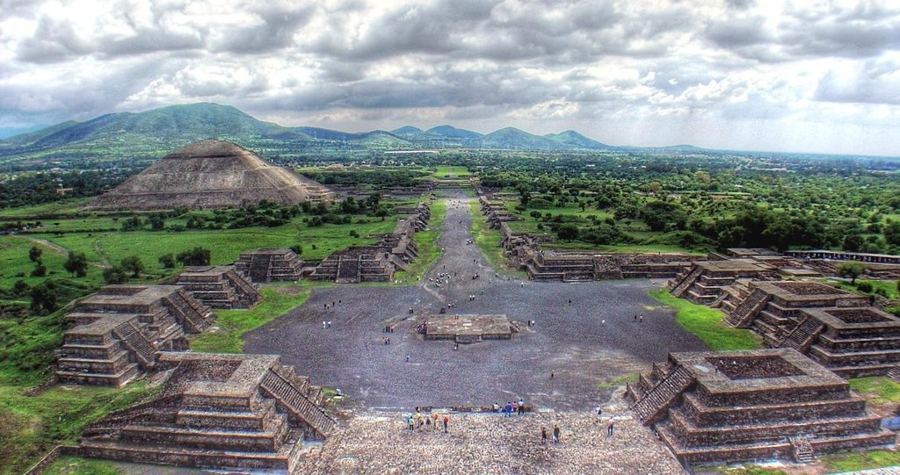 Transfer to station 3·01Teotihuacán early The Gulf Coast hall has a colossal Olmec head, a great helmeted face carved from a single block of basalt, among the oldest monumental sculptures in the Americas. The Oaxaca hall shows Zapotec and Mixtec work, including fine gold.
The Maya hall is one of the richest. Look for the carved stelae and lintels, the jade, and the reproduction of the tomb of the ruler Pakal from Palenque, entered down a stair as if you were going into the pyramid. In the garden outside, there are reconstructions of Maya buildings and their painted decoration.
Beyond the Maya hall, the halls for the west and north of Mexico are often quiet. The west hall is known for its lively clay figures from shaft tombs, including the plump dogs of Colima, musicians and village scenes. The north hall covers the desert cultures and the trading city of Paquimé, with its painted pottery and adobe architecture. If you have energy left, these are calm rooms to end the ground floor in.
Stand back and look at the Sun Stone from across the room before you go close; the scale only makes sense from a distance.
The ethnography floor
Many visitors never climb the stairs, which is a shame. The upper floor is about the indigenous peoples of Mexico today: dozens of cultures with their own languages, clothes, beliefs and crafts. Halls are dedicated to regions and peoples, such as the Huichol (Wixárika), the Maya, the Nahua and the peoples of Oaxaca, with full-size house reconstructions, textiles, ritual objects and masks. It is a reminder that the cultures downstairs did not disappear.
If your energy is fading, choose one or two halls above the ones you most enjoyed below, for example the Maya ethnography rooms above the Maya hall.
Pacing the visit
Plan on at least four hours. A simple order that works: Mexica hall first, while you are fresh; then Teotihuacan and Toltec; then a break in the courtyard; then the Gulf, Oaxaca and Maya halls; then one ethnography hall upstairs if you can. Benches are scattered through the halls, and there is a place to eat inside if you need a pause.
The museum is closed on Mondays. Weekday mornings are the quietest time; Sundays are very busy because entry for residents is often free. Signs are in Spanish with English text in many halls, and audio guides have been available.
Outside the entrance, you may see the voladores, men who climb a tall pole and spin down on ropes in a ritual from the Gulf Coast. They usually ask for a contribution afterwards. Getting there is easy: Auditorio station on Metro Line 7 is a short walk away, Chapultepec station on Line 1 is a longer walk through the park, and Metrobús Line 7 along Reforma stops nearby.