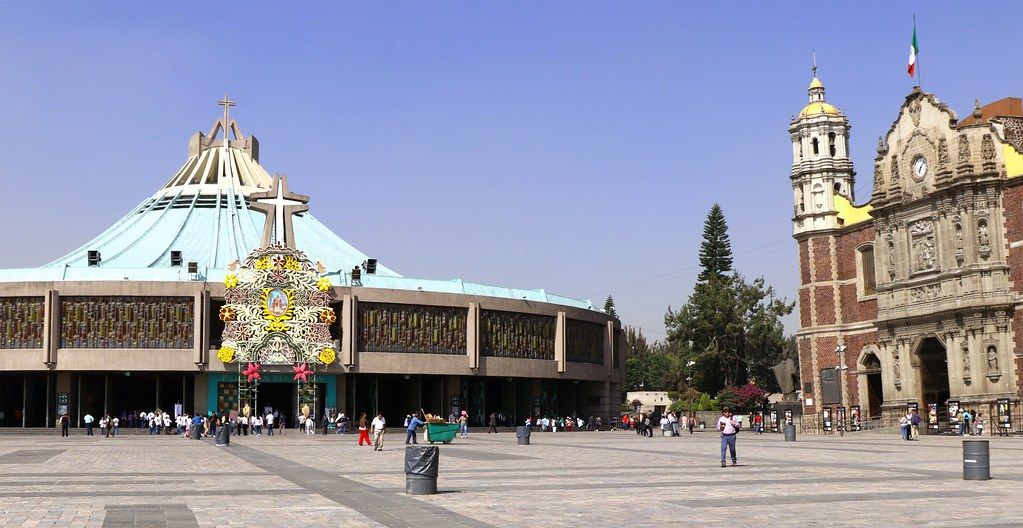
For millions of Mexicans, the Virgin of Guadalupe is more than a religious image: she is a national symbol, printed on candles, painted on walls and carried in protests and processions. Her home is the Villa de Guadalupe, a complex of churches and chapels at the foot of the Tepeyac hill, in the north of Mexico City. Even if you are not religious, it is one of the most moving places in the country to watch faith in action.
The story of Tepeyac
Catholic tradition holds that in December 1531, ten years after the fall of Tenochtitlan, an Indigenous man named Juan Diego saw a vision of the Virgin Mary on the hill of Tepeyac. She asked for a church to be built there. When the bishop asked for proof, Juan Diego returned with roses gathered from the hill in winter, wrapped in his cloak, his tilma. When he opened it before the bishop, the roses fell out and the image of the Virgin was found printed on the cloth.
The hill had been a sacred place before the conquest, linked to a Mexica mother goddess, and historians have long debated how the old and new beliefs met here. What is not in doubt is the devotion. The image became the most important religious symbol in Mexico, carried on banners in the war of independence and the Revolution, and Juan Diego was declared a saint in 2002.
The new basilica and the tilma
The large modern basilica, with its sweeping green roof shaped like a great tent, opened in 1976 to replace the old church, which had become unsafe. Designed by Pedro Ramírez Vázquez, the architect of the National Museum of Anthropology, it holds many thousands of people, and its open, round interior means almost everyone can see the altar.
The tilma hangs above and behind the high altar, framed in gold. To see it closer, find the passage behind the altar, where moving walkways carry visitors slowly beneath the image so that the crowd keeps flowing. You can ride them as many times as you like. Masses are held through the day, often one after another, and the church is rarely empty.
The old basilica and the sinking ground
Next to the modern church stands the old basilica, finished in the early eighteenth century, with its four corner towers and carved stone front. Like many buildings in the city, it stands on soft ground and has sunk unevenly over the centuries. Once you notice the lean, it is hard to stop seeing it: the towers, columns and floors are visibly out of true.
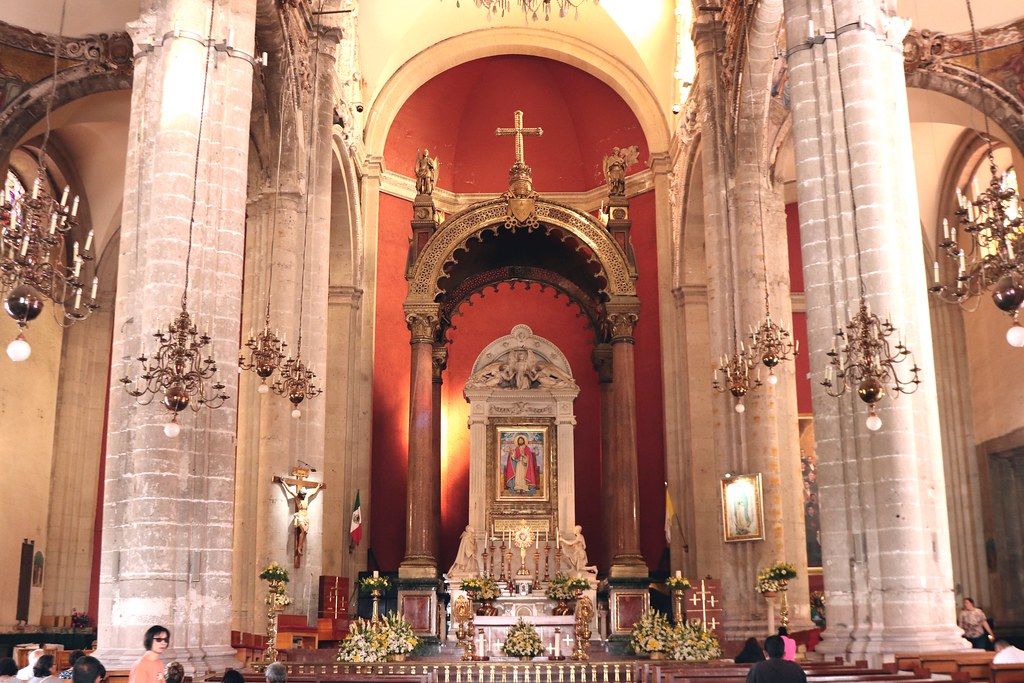
The old church was closed for years for structural work and has since reopened for worship, with a quieter, more traditional feel than the new building. 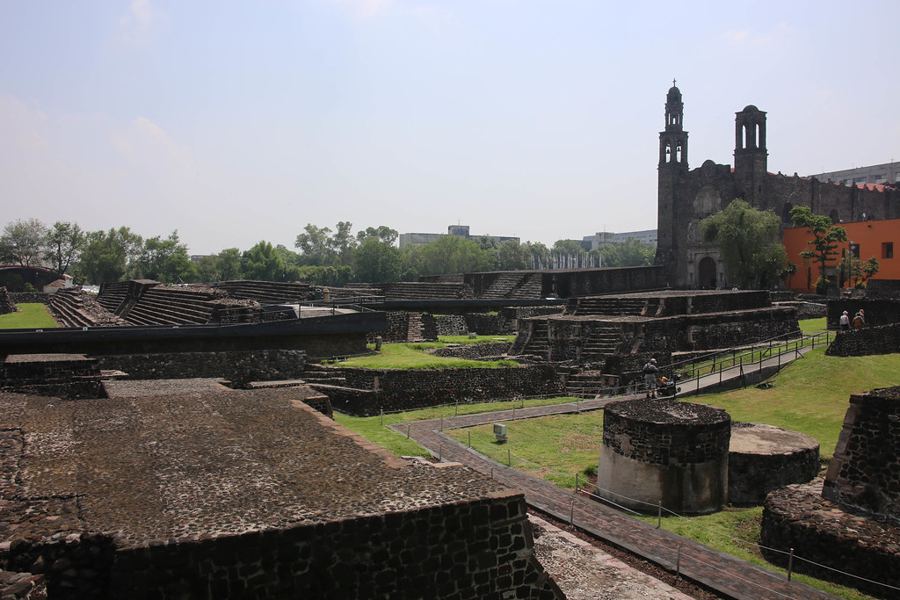 Transfer to station 1·07Tlatelolco and the Plaza of the Three Cultures Behind it, a small museum holds paintings, offerings and ex-votos given by pilgrims over the centuries.
Up the hill of Tepeyac
Behind the churches, paths and stairways climb the hill through gardens. Along the way you pass a large sculpture scene of Juan Diego offering the roses to the Virgin, set among rocks and flowers, and lookout points over the north of the city. At the top stands the Capilla del Cerrito, a small chapel built where the apparitions are said to have taken place, with murals inside.
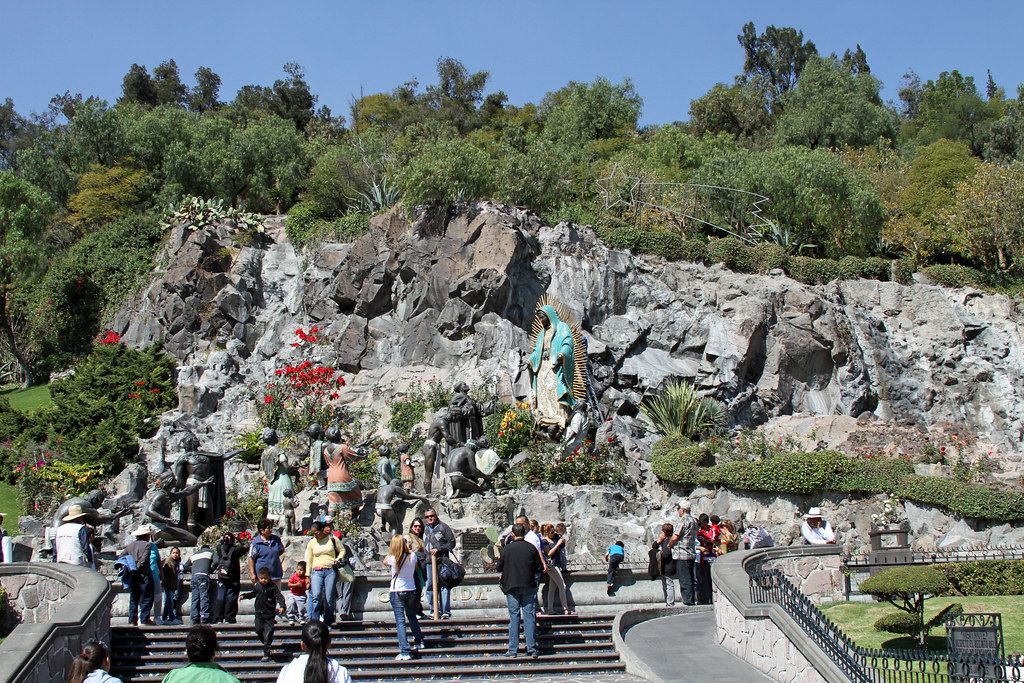
The climb is short but steep in places, and the altitude makes it feel harder. Take it slowly and use the stops. On the way down, a different path leads past the round Capilla del Pocito, built over a spring, with a tiled dome in blue and white. Taken together, the walk up the hill and through the plaza makes a gentle loop of an hour or so.
12 December and other busy days
The feast of the Virgin of Guadalupe falls on 12 December, and in the days before it millions of pilgrims arrive from all over Mexico and beyond. Many walk for days; some cover the last stretch on their knees. Groups arrive with bands, dancers in feathered costume and portable images of the Virgin. On the night of 11 December, crowds sing to her at midnight.
It is an extraordinary sight, but the crowds are dense, the streets around the basilica close to traffic and the Metro stations are packed. If you go, travel light, stay with your group, keep your phone and wallet out of sight and agree on a meeting point. If you want to see the place calmly, choose any other time of year. Sunday mornings are busy too, with families attending mass.
Visiting respectfully
This is a working shrine, not a museum, and people come here with serious hopes and griefs. Dress modestly: covered shoulders and no very short shorts. Keep your voice down inside the churches, do not walk in front of people at prayer, and avoid flash photography. During mass, stay toward the back or the side aisles if you are only looking. Entry to the churches is free.
Outside, the long avenue leading to the plaza is lined with stalls of religious goods, and it is fine to browse. Watch your belongings in the crowds, as in any busy public place.
The basilica is easy to reach on Metro Line 6 to La Villa-Basílica, a short walk from the plaza, and the guide to the Metro and Metrobús has tips on riding at busy times. It pairs well with the ruins and history of Tlatelolco, a short trip south, or with a morning in the Centro Histórico.