After the Revolution ended in 1920, Mexico's new government handed painters the walls of its public buildings and asked them to tell the country's story to people who could not read. The result was muralism, a movement that made Diego Rivera, José Clemente Orozco and David Alfaro Siqueiros famous far beyond Mexico. The richest concentration of their early work sits in the old streets just north and east of the Zócalo, close enough to see in one morning.
Why the Centro is the place to start
The murals here were painted in the 1920s and 1930s, when the movement was new and the painters were still arguing about what public art should be. The man behind the programme was José Vasconcelos, the education minister, who believed art and schooling together could build a new nation. He gave the painters scaffolding, wages and very large walls.
The three key buildings are the Secretaría de Educación Pública, known as the SEP, a few blocks north of the Zócalo; the Antiguo Colegio de San Ildefonso, a former Jesuit college around the corner; and the Palacio Nacional on the east side of the Zócalo itself. Each shows a different side of the movement, so seeing all three gives you the whole argument in miniature. If you are new to the area, read the guide to the Centro Histórico first for the lay of the land.
The SEP courtyards: Rivera's longest work
The Ministry of Education still works from the building, a former convent with two large courtyards, and the public is usually allowed in to see the murals on weekdays.
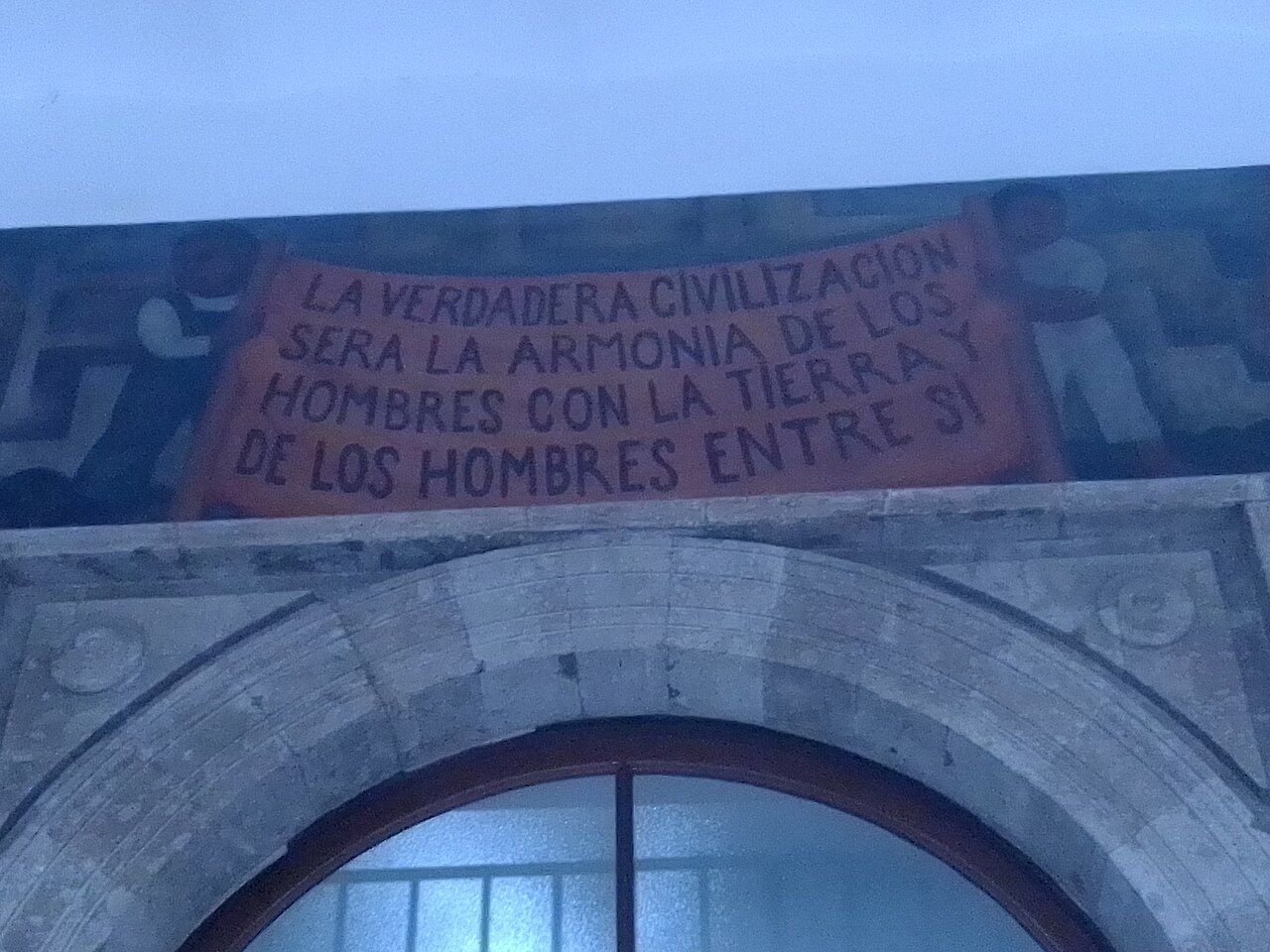
Rivera covered the walls of both courtyards and three floors of corridors between 1923 and 1928, well over a hundred panels in all. The ground floor of the first courtyard shows labour: miners going down a shaft, women dyeing cloth, peasants in the fields. Upstairs the tone turns sharper, with satirical scenes of the rich at dinner and a long run of panels set to the words of revolutionary songs. The second courtyard turns to festivals, with the Day of the Dead, ribbon dances and markets painted in strong, simple colour.
Take the stairs slowly and walk each floor all the way round. The panels follow on from each other, and much of the meaning comes from the sequence rather than any single scene. Look out too for the work of other painters in corners of the first courtyard, a reminder that Rivera was not the only artist hired here, only the one who took over.
San Ildefonso and Orozco
The Antiguo Colegio de San Ildefonso was a Jesuit school, then the National Preparatory School, and is now a museum run by the national university. Its large stone courtyards hold Orozco's murals, painted mostly in the mid-1920s, and they could hardly be more different from Rivera's.
Where Rivera tells stories, Orozco hits you with images. His figures are heavy, grey and often anguished: a mother and child, workers in a strike, a trench of soldiers, and on the main staircase a stark painting of Hernán Cortés and Malinche seated together, the conquest shown as a meeting of two bodies. He mocked the rich and the church but did not spare the revolutionaries either, and that doubt is what makes his work feel modern.
San Ildefonso also holds Rivera's first mural in Mexico, in the auditorium known as the Anfiteatro Bolívar, still close to the European style he brought back from Paris, and work by younger painters including Siqueiros. 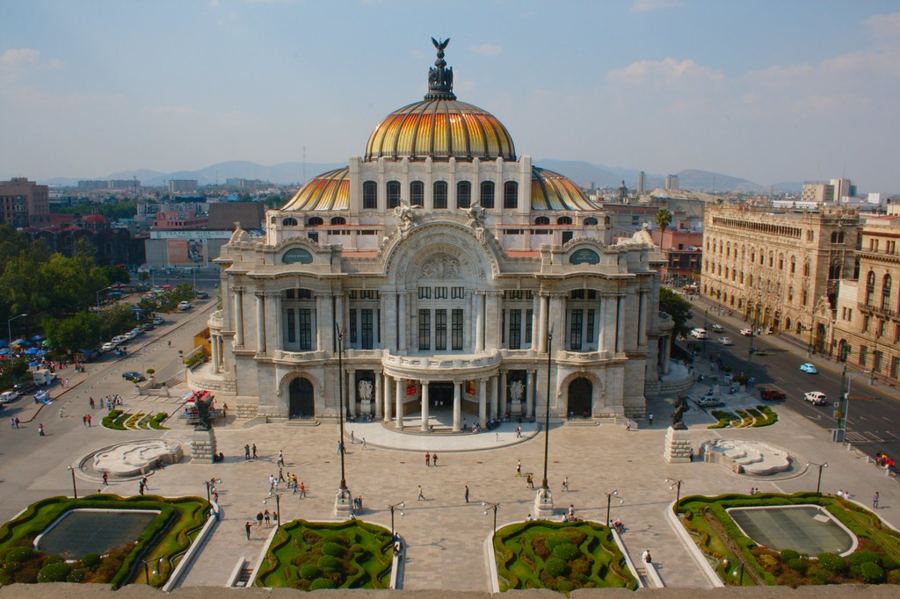 Transfer to station 2·02Palacio de Bellas Artes The museum charges an entry fee and stages large temporary exhibitions, so the opening days and what is on change through the year. Many museums in the city close on Mondays.
The Palacio Nacional staircase
The seat of government faces the Zócalo, and inside, on the main staircase, is Rivera's history of Mexico, painted between 1929 and 1935. It runs from the pre-Hispanic world on the right-hand wall, through the conquest and the colonial centuries in the centre, to the Revolution and a vision of a socialist future on the left. Karl Marx appears near the top, pointing the way.
Along the first-floor corridor, a later series shows life before the conquest in detail: the great market of Tlatelolco, crafts, farming and feasts, painted in the 1940s and early 1950s. Rivera never finished the full cycle he planned.
Access to the Palacio Nacional has changed several times in recent years, and on some days it is closed to visitors because of official events. Free entry has usually required photo ID, and bags may be checked at the gate.
How to read a mural
Murals were made to be read by people walking past, so they reward a method rather than a quick glance. Start by finding the direction of travel: most of these cycles move along a wall or up a staircase, and time usually runs from one end to the other. Then look for the centre of gravity, the figure everything else leans toward. On the Palacio Nacional staircase it is the eagle on the cactus; at the SEP it often changes from panel to panel.
- Find the heroes and villains. The painters had clear sympathies. Workers, peasants and Indigenous people are drawn large and dignified; bankers, priests and generals are often caricatures.
- Read the words. Some panels carry lines of song or slogans painted on ribbons and banners. Even a little Spanish helps here.
- Step back, then step close. Fresco is painted into wet plaster, so the surface has a soft, matte look up close. From a distance the composition takes over.
- Notice who painted what. Rivera tells stories, Orozco makes symbols, Siqueiros pushes shapes toward you as if they were carved. Once you see the difference, you will spot it all over the city.
Putting it together
A good morning starts at the SEP when it opens, moves around the corner to San Ildefonso, and ends at the Palacio Nacional, depending on whether it is open that day. Allow an hour for each, more if San Ildefonso has a large show on. The streets between them are busy and flat, so it is easy on foot.
If you still have energy, the Palacio de Bellas Artes, a short walk west, holds murals by all three painters on its upper floors, and the Ciudad Universitaria campus in the south shows what the movement became by the 1950s, painted and set in stone on the outside of buildings.