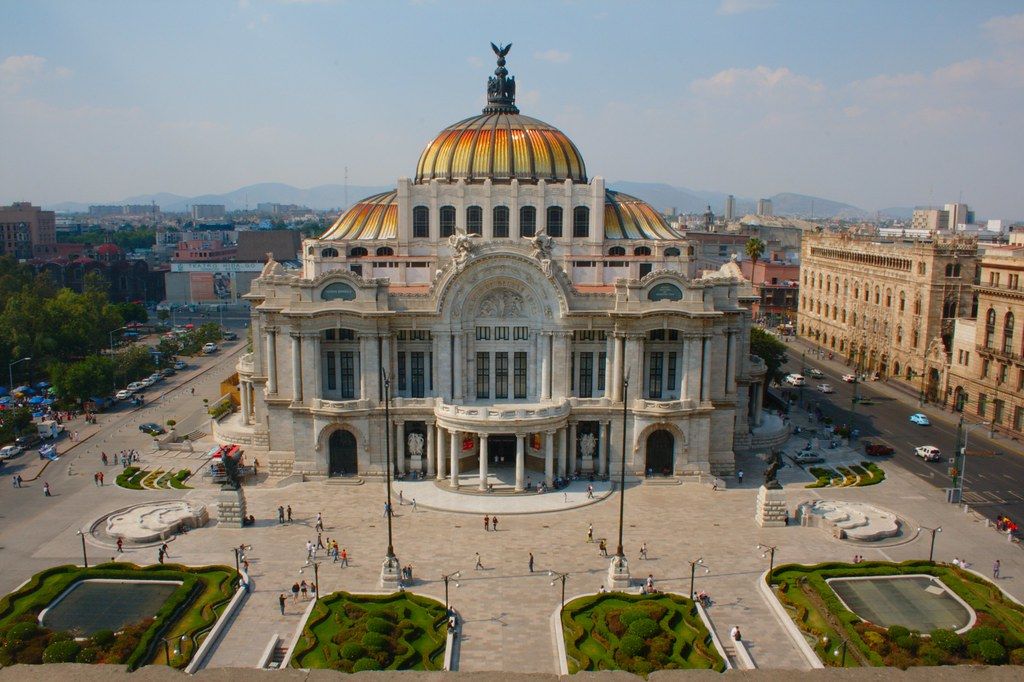
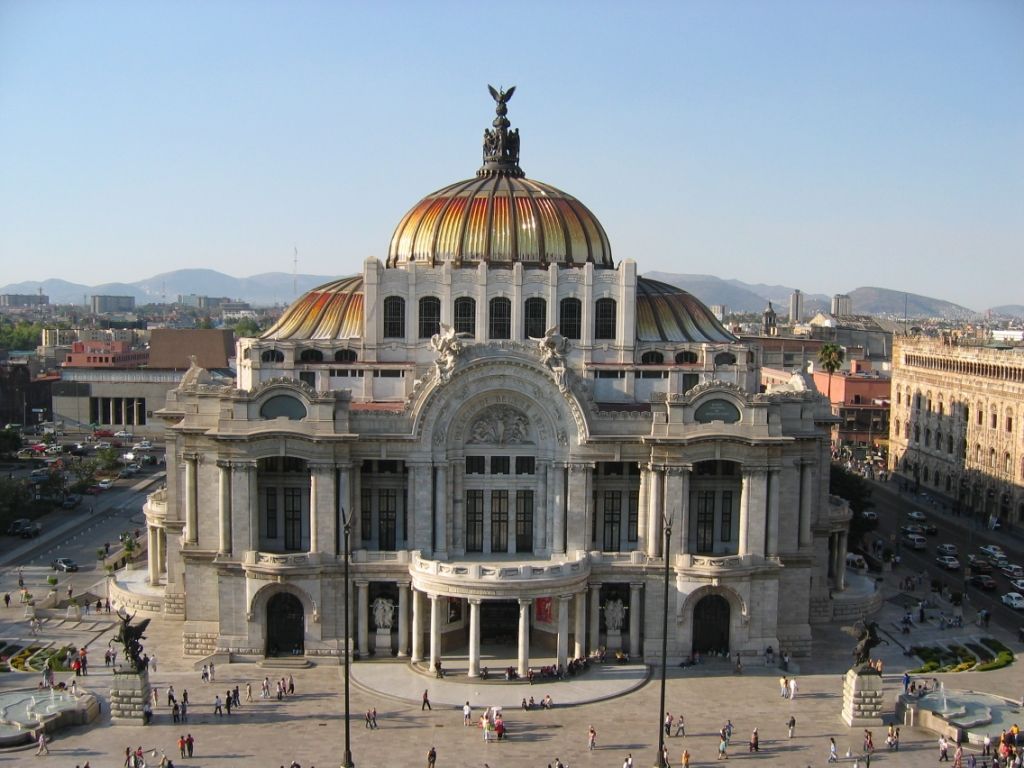
The Palacio de Bellas Artes stands at the western edge of the Centro Histórico, where Madero street meets the Alameda Central. Its white marble walls and orange and gold domes are some of the most photographed in the city. Inside, it is two things at once: the country's main stage for opera, dance and music, and a museum whose walls carry great murals by the most famous Mexican painters of the twentieth century.
A palace that took thirty years
The building was begun in 1904, under Porfirio Díaz, to replace an old national theatre and to show off Mexico at the centenary of independence in 1910. The Italian architect Adamo Boari designed it in an elaborate mix of art nouveau and neoclassical styles, with sculpted facades by European artists. Then the Revolution broke out, money ran short, and the building stood unfinished for years.
It was completed only in 1934, under the Mexican architect Federico Mariscal, who gave the interior a completely different character: art deco, with geometric patterns in marble and metal, and decoration drawn from pre-Hispanic designs. So the outside is a Porfirian palace and the inside belongs to the modern Mexico of the 1930s.
The sinking palace
From the start the building had a problem. Like the rest of the Centro, it stands on the soft clay of the old lakebed, and the weight of all that marble pushed it down. It began to sink even during construction, and over the decades it has sunk a long way, leaving the original ground floor well below the level of the surrounding streets. Look at the base of the building and at the steps leading down into the plaza around it, and you can see how far it has gone. Engineers have worked for years to slow and even out the settlement.
The murals
The murals are on the second and third levels around the main hall, and they are the reason to buy a ticket. The most famous is Diego Rivera's mural known as Man, Controller of the Universe. Rivera first painted it in 1933 for the Rockefeller Center in New York as Man at the Crossroads, but the patrons objected to a portrait of Lenin in it and the mural was destroyed. In 1934 he painted a new version here, showing a worker at the controls of a machine between visions of science, capitalism and socialism, and he kept Lenin in.
Facing it and on the neighbouring walls are works by the other great muralists. José Clemente Orozco's Catharsis is a violent, crowded scene of war and degradation. David Alfaro Siqueiros contributed several panels, including New Democracy, with a woman breaking free of her chains. Rufino Tamayo's two murals are calmer and more abstract. There is more by Rivera, including his panels on Mexican folklore and tourism, and works by Jorge González Camarena and others.  Transfer to station 2·01The National Museum of Anthropology in one visit If you enjoy these, see the Rivera cycle at Palacio Nacional and the other murals of the Centro.
The museum also holds temporary exhibitions in its galleries, often of Mexican and international art.
The glass curtain
The main theatre has one extraordinary feature: a stage curtain made of glass. It was made, from a Mexican design, by the New York firm of Louis Comfort Tiffany in the early twentieth century, from close to a million small pieces of iridescent glass. It shows the Valley of Mexico with the two volcanoes, Popocatépetl and Iztaccíhuatl, and when it is lit from behind it shifts through dawn and dusk colours. The curtain is generally shown before some performances, and at times on scheduled viewings; check what is on.
The ceiling of the theatre is another piece of glass art, a round lamp of glass panels with figures from Greek mythology. Above all, if you can, see a performance. The Ballet Folklórico de México, a long-running company of regional dance, performs here regularly, and there are opera and orchestra seasons. Tickets are sold at the box office and online.
The Alameda Central outside
Bellas Artes faces the Alameda Central, a park laid out in the late sixteenth century and often described as the oldest public park in the Americas. It has fountains, paths of old trees and benches, and, along its south side, the white marble semicircle of the Hemiciclo a Juárez, a monument to Benito Juárez. The park was renovated in the 2010s and is a good place to sit before or after the museum.
At the western end of the Alameda, the Museo Mural Diego Rivera holds his large mural Dream of a Sunday Afternoon in the Alameda Central, moved there after the 1985 earthquake damaged its original building. It fills a whole wall with figures from Mexican history strolling in the park, including Rivera himself as a boy, Frida Kahlo and the famous skeleton lady, La Catrina.
Practical sense
Bellas Artes Metro station, on Lines 2 and 8, comes up right beside the palace. From the Zócalo, it is a fifteen-minute walk west along Madero, which makes it the natural end to a walk through the Centro Histórico. From the Monument to the Revolution, it is a short walk east.
There is a security check at the entrance, and large bags may need to be left. Allow an hour for the murals and the building; add more for a temporary exhibition. In the evening, the palace is lit up, and the view of its domes from the plaza and from the terraces around the Alameda is one of the best in the city.